
Don’t you have that friend who just discovered that a chatbot can generate a landing page in forty seconds? “I could build that in a day”. They look at a product and, because they can picture the core logic, they believe they’ve understood the work. They haven’t. Or better, they’ve understood one-ninth of it.
Fred Brooks explained this in 1975 in his The Mythical Man-Month. I read it recently, and for a good part it’s clear he’s picturing a prehistoric world of software engineering. But at its core, many of those intuitions are more than relevant today.
Two golden ages of software engineering have passed since then, but the underlying concepts remain, one of which is the misconception of what a real product running in production actually is.
Programming Systems Product
Program
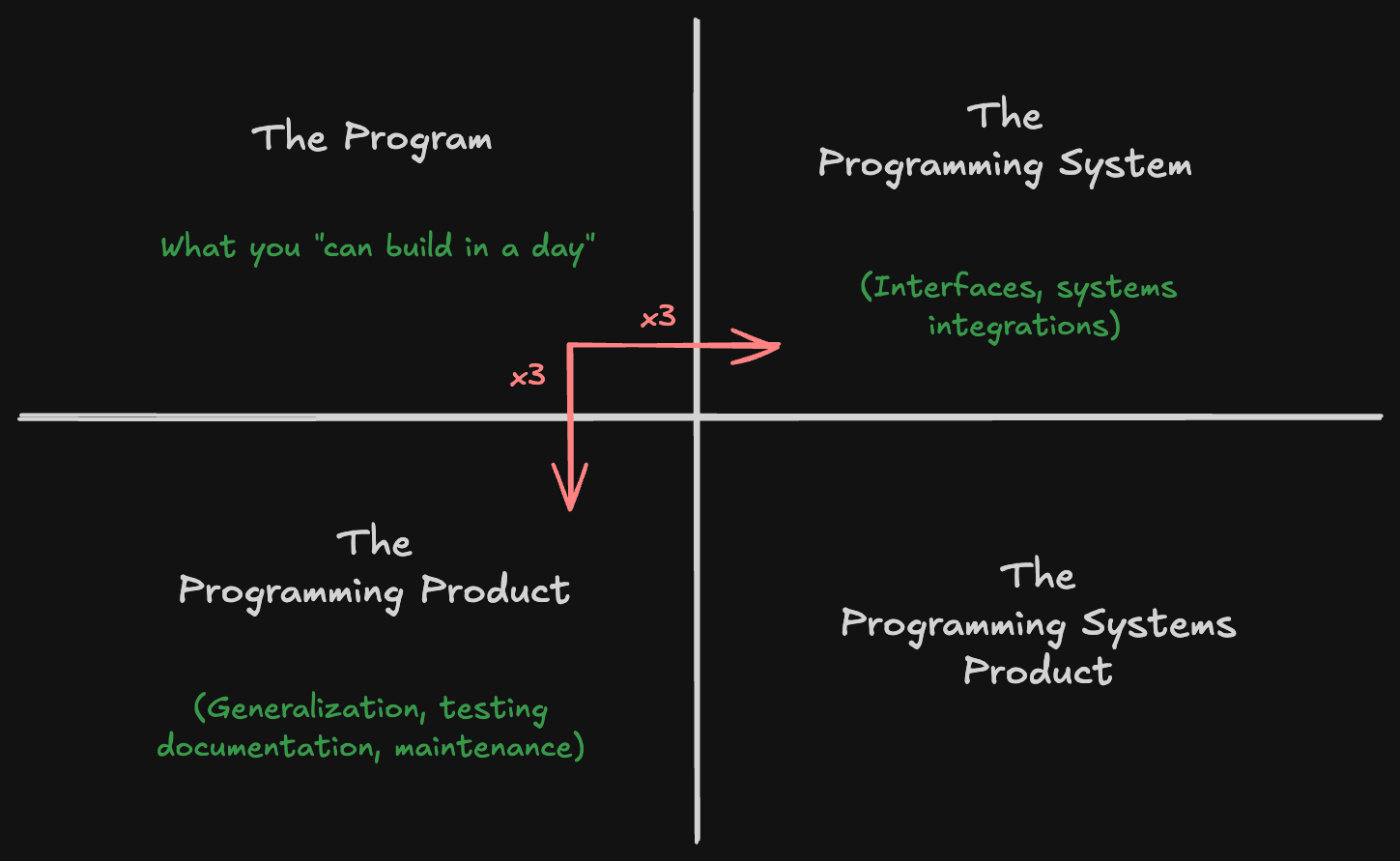
He draws a simple diagram with four quadrants. In the top-left corner sits the Program, a more or less complex application that “runs on one machine, for one person, solving one problem”. This is the part that, more than anything else, automatic programming has sped up a lot. Today I’d rewrite that sentence to give AI more credit: what you can possibly ship in a day (depending on the case) is much more than something a single user can run on their machine. In any case, that’s the thing you “build in a day”.
Programming Product
With a multiplication of the effort (he approximates it at 3x, clearly a simplification, and today the ratio is even different) you can transform your program into a Product through generalization, testing, documentation, and (a lot of) maintenance.
Regardless of the research you’ve done ahead of time, your users will need a feature you haven’t thought about, an SSO provider you haven’t implemented because of the additional complexity, they prefer CSV export instead of JSON, and so on.
The number of bugs and edge cases they’re able to find running your product in every possible absurd condition is incredible: old devices, niche browsers, network conditions, unexpected behaviors.
A note on documentation: who are the users of your product? You are required to document not only for your end users (including landing pages, wizards, hover text, external links, tutorials) but for yourself in the form of runbooks and today living documentation for coding agents. If the project also has an open-source nature, or you have colleagues, you’re better off documenting how to collaborate, what the architecture of the codebase is, and so on. If you’re building a B2B product, I can assure you that you need to document a lot of stuff that nobody will read, but often needed for some sort of compliance.
Programming System
Through another multiplication of the effort you can get to a Programming System. Especially when software lives inside a company, or you start getting serious with what you’re building, it rarely runs in isolation. It connects to other tools, services, and systems, and that web of connections changes everything dramatically.
The moment your program starts talking to other programs, complexity multiplies. Inputs and outputs need to be carefully managed, integration testing becomes essential, and things like monitoring and scaling turn into real challenges instead of afterthoughts.
This shift from a standalone program to a piece of a larger system carries a price tag similar to going from a script to a product. Plugging something properly into an ecosystem takes far more effort than building the thing itself.
If you start to have departments (it can just be yourself wearing multiple hats) you’ll discover the number of tools for all sorts of bureaucracy that you need to, in one way or another, integrate into your workflow just to keep the lights on.
Programming Systems Product
With all that said, finally, in the bottom-right corner sits the Programming Systems Product, which has the same core logic as your original product but generalized for strangers, tested until unbreakable, documented for people who will never meet you, and integrated into a living system of other components that all share resources and fail in creative ways.
The distance between the two corners is not incremental. It is a multiplier. “Three” times the effort to turn your script into something anyone can use. “Three” times again to make it coexist with everything else.
AI
Brooks’s multipliers assumed deterministic software. In 2026, some of the components you’re probably integrating are non-deterministic, and that changes the nature of the work at every level.
When your program enters a modern ecosystem, you aren’t just managing state. You are managing orchestration and observability across a distributed, often “black-box” network. Standard error logging doesn’t cut it anymore. If a logic error occurs somewhere in a chain of five different models or services, you need to trace it semantically, not just structurally. Worse, outputs can drift silently over time, breaking downstream services in ways that no traditional test suite would catch.
And when the software itself is built primarily by agents, the Product quadrant introduces a new kind of problem: volume. Automatic programming creates code faster than human engineers can review it line by line. The “source of truth” starts to drift between the developer’s intent, the prompt used to generate the logic, and the resulting code. Without deliberate effort to keep these aligned, the agent gradually loses its mental map of the project. New additions begin to break existing features in unpredictable ways. Call it context rot: a form of technical debt that doesn’t come from laziness or shortcuts, but from the sheer speed at which code is now produced.
This also means that in 2026, a Product isn’t just documented for humans. It is documented for coding agents. You need high-density context maps and runbooks that agents can consume to fix bugs or navigate the architecture autonomously. If your system isn’t “agent-readable”, it is already legacy.
Today tools are real. You can generate a working prototype faster than ever, and the gap between “I have an idea” and “I have a demo” has collapsed to hours. That part is genuine progress.
But the gap between “I have a demo” and “I have a product” hasn’t moved. If anything, it’s wider, because the demo now arrives so fast that people have even less patience for what comes after. The prototype feels like the finish line. It is the starting gun.
Especially because you’re not the only one to have gained that power.
Distribution
Something Brooks couldn’t even imagine at the time, but that we’re very aware of today, is Distribution.
Today, distribution is the final, invisible multiplier. The world is drowning in high(er)-quality noise. You are no longer competing against the difficulty of the syntax, you are competing against the infinite supply of “good enough” software generated by everyone else with a prompt.
Think about what that means concretely. Ten years ago, if you built a decent project management tool, your competition was the handful of teams with the engineering resources to do the same. Today your competition is anyone with an idea and a weekend. The barrier was syntax, now the barrier is attention. And attention doesn’t scale the way servers do. You can’t throw more compute at it. You can’t automate it away. Getting a stranger to care about your product long enough to try it, that is a problem that resists every shortcut the last two years have given us.
In this landscape, technical elegance matters zero (despite the fact I think it’s absolutely crucial) if you cannot bridge the gap to the user. Distribution is no longer a department that handles the “launch”. It is an architectural constraint. In an era of low-cost production, the only remaining scarcity is human attention, and solving for that is more complex, more expensive, and far more volatile than any legacy codebase.
The “built in a day” fallacy hasn’t disappeared. It has simply shifted its coordinates. AI has commoditized the first quadrant, turning the “Program” into a disposable artifact. But the remaining work of hardening, integrating, and distributing remains as resistant to shortcuts as it was in 1975.
The challenge of software engineering has evolved from “How do we build this?” to “How do we make this survive the noise?”.
If you liked this post, consider subscribing to receive new posts, or sharing it on Hacker News.