
Every time you touch a keyboard, you leave a fingerprint. Not on the keys, but in the rhythm. And this isn’t new. It’s 160 years old.
Telegraph operators in the 1860s could identify each other across hundreds of miles by the cadence of their tapping alone. They called it “the fist”. Military intelligence in World War II used the same principle to distinguish allied transmissions from enemy deceptions. No encryption. No codebook. Just the involuntary rhythm of a human hand.
Now think about what you do every single day. Emails. Slack messages. Login forms. Search bars. You hammer out thousands of keystrokes, and buried inside that noise is a biometric signature as unique as the way you walk or the way you sign your name.
The field is called keystroke dynamics.
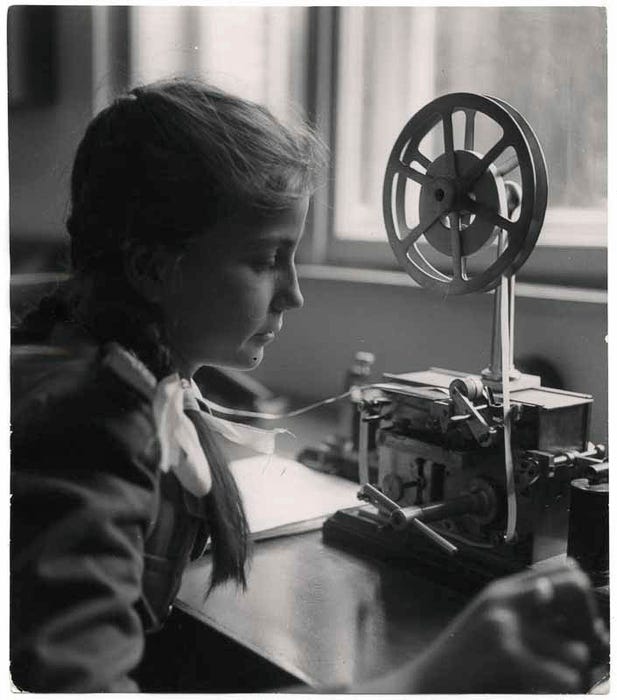
The Anatomy of a Keyprint
When you type a word three things happen that you will never consciously notice. First, there’s a dwell time: how long your finger presses down on each key, measured in fractions of a millisecond. Second, there’s a flight time: the gap between releasing one key and striking the next. Third, there’s a latency: the full arc from first press to second release.
Stack these measurements across every pair of keys you type, every digraph, every trigraph, and you get a timing profile. A rhythm. A signature written not in ink, but in the micro-hesitations of your nervous system.
This is not something you can fake. You didn’t learn it or chose it. Your motor cortex and your muscle memory built it over years, and it runs underneath your conscious awareness like a second heartbeat.
Old Tools, New Forge
Early researchers in the 1980s (Gaines, Umphress, Williams) proved the concept with crude statistical models. Euclidean distance. Manhattan distance. Measure the gap between a stored profile and a live sample. If the numbers are close enough, you’re in.
The problem was the same problem that plagues every craft when it’s young: the tools were blunt. Statistical models couldn’t handle the chaos of free-form typing. They needed you to type the same password, the same way, over and over. Fixed text. Controlled conditions. A laboratory exercise pretending to be a real-world system.
Then machine learning arrived. SVMs (Support Vector Machines) delivered under 1% average error rate on 500 keystrokes of free text. Decision Trees pushed past 93% AUC (Area Under the Curve, a measure of classification performance) with just a few keystrokes. Traditional ML was solid, but ultimately limited by hand-crafted features and fixed-length inputs.
The real interesting stuff started with deep learning. Recurrent networks could finally model what typing actually is: a sequence, a temporal stream with dependencies stretching across dozens of keystrokes. CNN+RNN hybrids drove the Equal Error Rate (where false accepts equal false rejects) down to 2.67% on the Buffalo/Clarkson datasets using just 30 keystrokes. RNNs scaled to 168K subjects and still held 2.2% EER on desktop data. Then Transformers arrived and pushed it further, 3.25% EER on mobile with as few as 30 keystrokes across 60K users. Deep learning didn’t just improve keystroke biometrics; it made them viable at scale.
And then came the Transformers.
TypeFormer, a self-attention architecture built specifically for keystroke sequences, achieved an Equal Error Rate of 3.25% on the Aalto Mobile database using just 30-100 keystrokes. The previous Transformer-based result on the same dataset sat at 3.84% EER with a fixed 50-keystroke window. Meanwhile, the best RNN approach hit 9.2% EER, though on a different mix of datasets, so it's not a clean apples-to-apples comparison. Still, TypeFormer didn't just edge out the competition: it set a new bar for keystroke biometrics with fewer keystrokes and a flexible input range.
Authentication
There are three ways to deploy keystroke biometrics as a supporting authentication mechanism.
Fixed-text authentication asks you to type a known string (a password, a PIN etc). It’s easy to build, easy to profile, and easy to understand.
Free-text authentication watches you type anything like an email, a document, a chat message, and verifies your identity from the rhythm alone. Historically, it needed 500 or more characters to work. Modern deep learning does it in 40 to 60 keystrokes. About two sentences.
Continuous authentication is worth more attention than it gets. It runs quietly in the background, monitoring patterns like keystroke rhythm throughout a session. If the pattern shifts (say, someone else sits down at your keyboard) it triggers a security notification or simply locks the door, prompting for a second layer of authentication. The system already knows you left. It knew before you did. This aims to shift security at the intrinsic architecture level, like the difference between a lock on the front door and a house that knows who’s inside every room at every moment.
This is clearly at the research level and we know that every system has attack surfaces, this one is no different.
Injection attacks are real. Researchers have built rogue USB implants that sit inside a keyboard and replay a victim’s timing pattern with 93 to 96% accuracy on fixed-text systems. Humanoid robots have shown the ability to significantly degrade the performance of these detectors in white-box scenarios by imitating human gestures with high precision. Attackers can sample inter-keystroke intervals from empirical human distributions and forge passable imitations.
The defense? Liveness detection. Systems that look for micro-jitters: the tiny, involuntary tremors in human motor control that no replay attack or robotic actuator can perfectly replicate. Randomized challenge prompts. Multi-modal fusion, combining keystroke rhythm with mouse dynamics, device motion, even gait patterns, to create an identity surface so complex that forging one channel means nothing if the other three don’t match.
Anyway, every organization that relies on a single authentication factor is building on a foundation with exactly one crack needed to fail. Keystroke dynamics clearly doesn’t replace those layers alone.
Tracking
The marketing attribution landscape is shifting toward privacy-centric “cookieless” strategies that prioritize first-party data and server-side tracking.
Server-side tracking has emerged as a critical alternative, moving data processing from the user’s browser to a brand-controlled server to bypass ad blockers and browser-level restrictions like Apple’s Intelligent Tracking Prevention (ITP). Identity resolution solutions, such as Unified ID 2.0 (UID2), provide another durable path by using hashed and salted email or phone data to recognize users across different platforms.
It is important to note that while keystroke dynamics can technically “fingerprint” a user, it remains a biometric signal distinct from these commercial frameworks. Marketers are increasingly utilizing machine learning for behavioral and conversion modeling to fill data gaps, alongside Google’s Privacy Sandbox APIs, including the Topics API for interest-based targeting. However, current research does not link keystroke dynamics to the implementation of UID2 or the Privacy Sandbox, as these standards prioritize aggregated or deterministic data rather than individual behavioral biometrics. These frameworks often blend deterministic attribution, which relies on exact matches like login credentials, with probabilistic models that use statistical signals to estimate the impact of anonymous user journeys.
And more
Changes in typing speed, inter-key delay, and error frequency are emerging as passive digital biomarkers for Mild Cognitive Impairment. Your keyboard can detect neurological decline before you notice it yourself. Older users exhibit measurably slower, more variable typing patterns, and tracking those patterns over months or years creates a longitudinal health record that requires no clinic visit, no blood draw, no conscious effort from the patient. Your keyboard becomes a diagnostic instrument, not because someone engineered it to be one, but because the signal was always there. We just never measured it.
In education, platforms like Coursera use keystroke dynamics to verify that the student registered for a course is the one taking the exam. No webcam. No surveillance theater. Just rhythm.
In forensics, an anonymous account means nothing if the typing pattern behind it matches a known profile. Age, gender, linguistic background, all encoded in the timing between keys and how long you press them.
Privacy
Under GDPR and the UK Data Protection Act, biometric data used for identification is classified as special category data. You need explicit, informed consent. You need a Data Protection Impact Assessment. And you absolutely cannot store raw keystroke logs.
The correct approach is template conversion, transforming timing data into anonymized mathematical representations that cannot be reversed to reveal what was typed. Data minimization isn’t optional. It’s the law.
This is the razor’s edge. The same technology that can protect a user’s identity can, if mishandled, become the most invasive surveillance tool ever deployed on a consumer device. The difference is entirely in the architecture of the system, what you store, what you discard, and whether the human on the other end of the keyboard ever gave you permission.
You could be already broadcasting a biometric signal every time you type. Every email. Every search query. Every password. The rhythm is uniquely yours, shaped by your neurology, your muscle memory, your years of habit.
The question isn’t whether this signal exists. It does. It has since the telegraph.
The question is who’s listening. And whether the systems being built around it are designed as fortresses, or as traps.
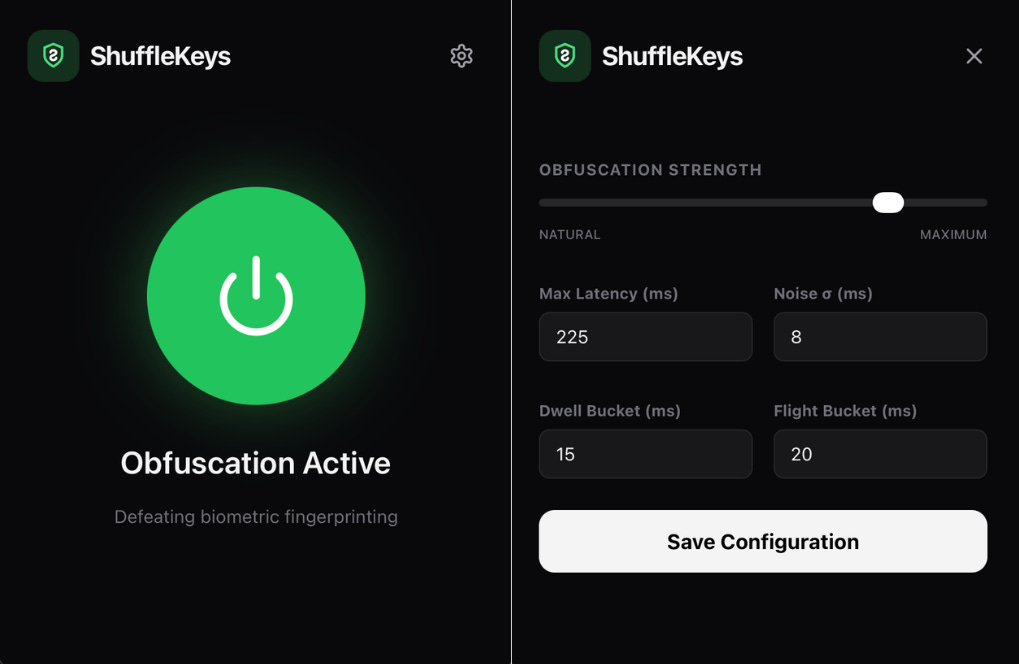
BTW: I turned this rabbit hole into ShuffleKeys, a fully open-source keystroke dynamics obfuscator. If any of this got you thinking, contributions and beta testers are very welcome!
ShuffleKeys - OS Keystroke Dynamics Obfuscator on Github
If you liked this post, consider subscribing to receive new posts, or sharing it on Hacker News.
Refs
Keystroke dynamics as a biometric for authentication - ResearchGate
What’s Your Type? Keystroke Dynamics as Behavioral Biometrics
Keystroke-based User Identification on Smart Phones - Genetic-Programming.org
Privacy: Gone with the Typing! Identifying Web Users by Their Typing Patterns
Keystroke Dynamics for User Authentication and Identification by using Typing Rhythm - IJCA
The Improved Biometric Identification of Keystroke Dynamics Based ...
Fast Free-text Authentication via Instance-based Keystroke Dynamics
Authentication by Keystroke Dynamics: The Influence of Typing Language - MDPI
TypingDNA on Mobile Phones: Best Practices for Browser and Native Integrations
Using Keystroke Dynamics Behavioral Biometrics to Identify Users - OpenRiver
A Survey of Biometric keystroke Dynamics: Approaches, Security and Challenges - arXiv
Keystroke Dynamics: Concepts, Techniques, and Applications - arXiv
A Deep-Learning-Based Approach to Keystroke-Injection Payload Generation - MDPI
Keystroke Dynamics for Continuous Authentication - ResearchGate
Authentication API - Keystroke Dynamics for Your App - TypingDNA
Exploring Age-Related Patterns in Smartphone Keystroke Dynamics - JMIR
Exploring Age-Related Patterns in Smartphone Keystroke Dynamics - PMC
Biometric Authentication in Exams: 6 Key Privacy Concerns & Solutions - Proctor360
User attribution through keystroke dynamics-based author age estimation - Bournemouth University
Age and Gender as Cyber Attribution Features in Keystroke Dynamic-Based User Classification - MDPI
User Authentication Method Based on Keystroke Dynamics and Mouse Dynamics - PMC